Drone Chimney Survey
Chimney Survey
Close aerial photographs of a chimney stack, pots and cowls, flaunching, flashing and soakers, brickwork and pointing, taken close enough for a sweep or a roofer to read.
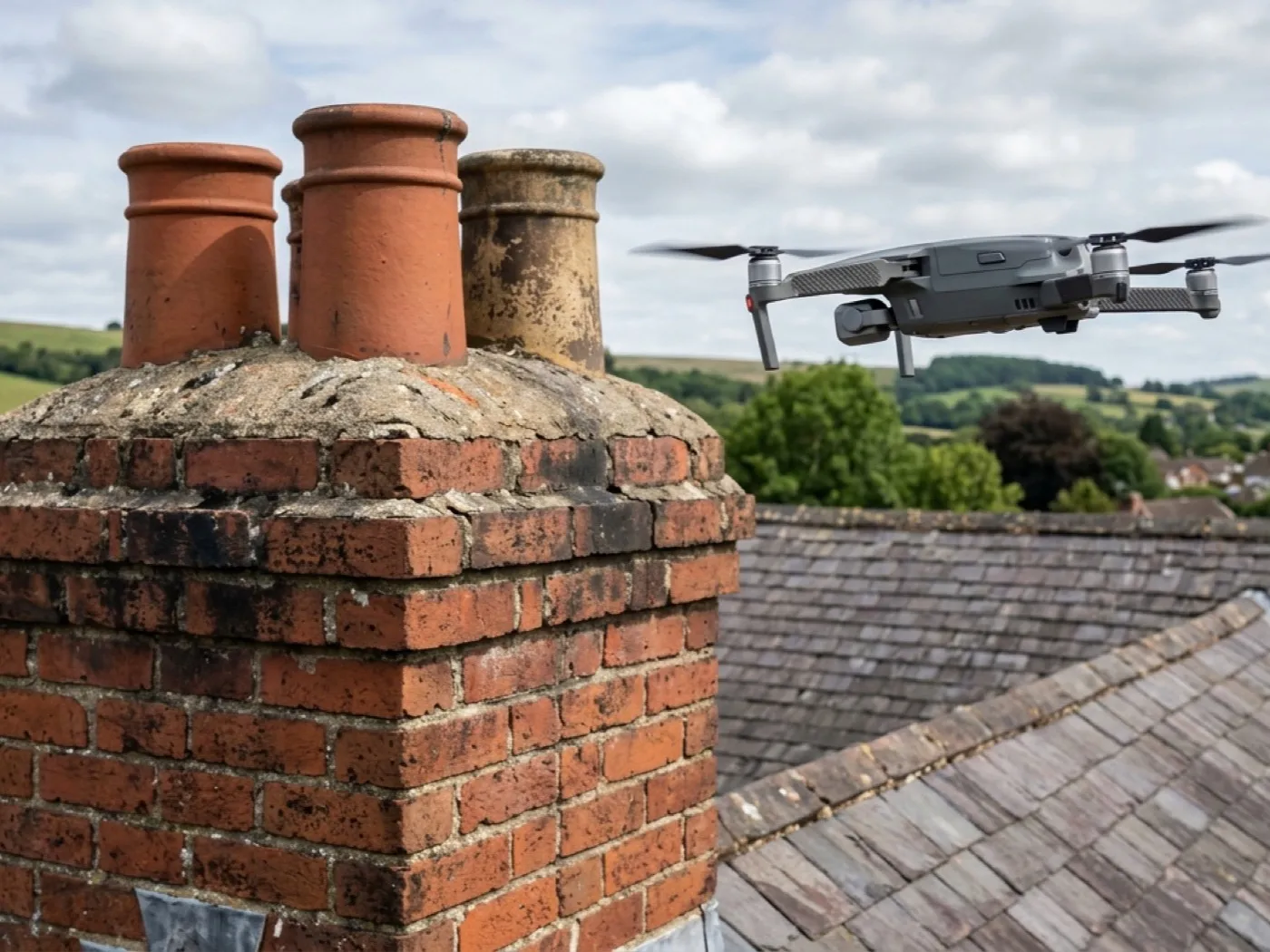
A stack is the one part of a house nobody actually looks at. It is above eye level from every window, most of it cannot be seen from a ladder without someone standing on the roof beside it, and a pair of binoculars from the garden only ever tells you that something looks off, not what it actually is.
That is normally where this survey gets booked. A damp patch has turned up on the chimney breast inside, or a pot looks like it is leaning, or a roofer mentioned the flashing in passing on a job that was really about something else, and nobody wants to put a ladder against a stack just to find out whether it is worth worrying about.
A flown survey works around the stack from a safe standoff distance, photographing every face at high resolution, then closing in on the details that actually decide whether a stack needs work: the flaunching around the pots, the lead flashing and soakers where the stack meets the roof, the brickwork and the pointing, and whether the stack itself is standing straight.
What is included
- Every face of the stack photographed at 100 megapixels, close enough to read a mortar joint
- The flaunching around each pot checked for cracking and separation from the pot
- Flashing and soakers checked where the stack meets the roof covering
- Brickwork and pointing checked for perishing, spalling and staining that suggests water is tracking down from above
- A visual check for lean, using the stack's own coursing lines against the vertical rather than a guess from the ground
- Chimney pots and cowls checked for cracks, a secure fit and a clear flue opening
- A written report within 48 hours, with a plain description of what was found and where
- Full resolution originals, so a sweep or a roofer can look at the same images rather than take a description on trust
What actually fails on a stack, and why it is hard to see
A chimney takes more weather than almost anything else on a house. It stands proud of the roofline into the wind, it carries the coldest and wettest surface on the building through most of a Devon winter, and on an older stack the mortar holding it together is often decades past what it was originally laid with. Flaunching, the mortar collar around the base of a pot, is usually the first thing to go: it cracks, pulls away from the pot, and lets water track straight down inside the stack rather than off the top of it.
Flashing and soakers, the lead or zinc detail where the stack meets the roof covering, fail in a way that shows up nowhere near where the problem actually is. A lifted flashing lets water in behind the stack, which can travel a surprising distance under the roof covering before it ever reaches a spot where it shows as a stain on a ceiling, so the damp patch on a chimney breast and the actual failure a metre away are two different questions.
Brickwork and pointing decay more slowly but more permanently. Perished pointing lets water into the joints, which on a cold night can freeze, expand and push brick faces apart, spalling the surface. A rust-brown stain running down brickwork below a pot is usually a sign that water has been tracking from a failed joint above for some time, not a one-off mark.
What the report gives you
A written note on each part of the stack, in plain language: the pots and cowls, the flaunching, the flashing and soakers, the brickwork and pointing, and whether the stack is standing straight. Where something looks like it needs attention, the report says so and describes what was seen, not what the repair should cost, because pricing the work is the sweep's or the roofer's job, not this survey's.
Full resolution images go with the report, so whoever ends up quoting the work can zoom into the actual detail rather than work from a written description alone. A cracked crown, a lifted flashing or perished pointing reads very differently in a sharp close photograph than it does in a sentence about it.
Why a stack is worth flying rather than climbing
Getting eyes level with a chimney pot usually means scaffolding, which is expensive and slow to arrange for what might turn out to be a five minute look, or a ladder pitched against the stack itself, which is not a comfortable place to be balanced while also trying to inspect mortar joints closely. Neither is proportionate for finding out whether a stack actually needs work.
A drone survey looks at the whole stack from a standoff distance that a ladder cannot get to, at a resolution that resolves the detail a ladder view would give you anyway, without anyone standing on a roof or leaning anything against the chimney to get there.
On the day
How a the chimney survey runs
- Step 1
What you tell us first
Where the damp patch shows inside, whether a pot looks off from the ground, and anything a sweep or roofer has already flagged. It shapes where the flight spends its time.
- Step 2
Site check
The address is checked for airspace restrictions and a lawful take off point before the booking is confirmed, so nothing gets discovered on the day.
- Step 3
The flight
A methodical pass around every face of the stack at high resolution, then close work on the pots, the flaunching, the flashing and any brickwork that looks worth a second look.
- Step 4
The screen check
Before packing up, the imagery is reviewed on site. If an angle was missed or a detail is unclear, it gets reflown there and then rather than discovered back at the desk two days later.
- Step 5
The report
Images sorted and annotated, a plain written description of what was found and what it is likely to mean, in your inbox within 48 hours.
Behind the work
Kit, cover and qualifications
CAA registered
Operator ID and Flyer ID held, plus the A2 Certificate of Competency. Every survey is planned to the rules that apply to the site, and the paperwork is available before the visit if your sweep, roofer or agent wants it.
100 megapixel camera
A DJI Mavic 4 Pro with a Hasselblad camera and 6K video, close enough from a safe standoff distance to read a mortar joint or a hairline crack in a flaunching collar without leaning anything on the stack.
Radiometric thermal option
A DJI Mavic 2 Enterprise Advanced carrying a 640 by 512 thermal camera, flown alongside the visual pass where a damp pattern on a stack needs reading against the brickwork around it.
Insured with Coverdrone
Full commercial cover for the operation. Certificates go to sweeps, roofers, letting agents and insurers as a matter of course, without anyone having to chase for them.
The chimney survey
Chimney Survey questions
- Will you tell me if the stack needs to come down?
- The report describes what was found, lean, cracking, brickwork condition, and what it suggests. Whether a stack needs rebuilding, repointing or leaving alone is a judgement for whoever prices the repair, using the images and the written description as their starting point rather than a guess from the pavement.
- Can you see inside the flue?
- No. This is an external visual and, where useful, thermal survey of the stack itself. Sweeping and internal flue inspection is a chimney sweep's job, and the two are complementary: the sweep clears and checks the inside, this survey shows what the outside of the stack actually looks like from a height nobody else gets to.
- What if the stack is shared with next door?
- Common on a lot of the terraces this site covers. The whole stack gets photographed either way, and the report simply notes which parts belong to which property where that is relevant, so you have an accurate record even if a shared repair conversation with a neighbour follows.
Where
Chimney Survey across the South West
Also on this site
For the parts you cannot see from the ground
Book a chimney survey with Drone Chimney Survey
Tell us the address and what you need looking at. Sam Hembury will come back with a fixed price and the next available slot.