Devon · TQ12
Drone chimney survey in Newton Abbot
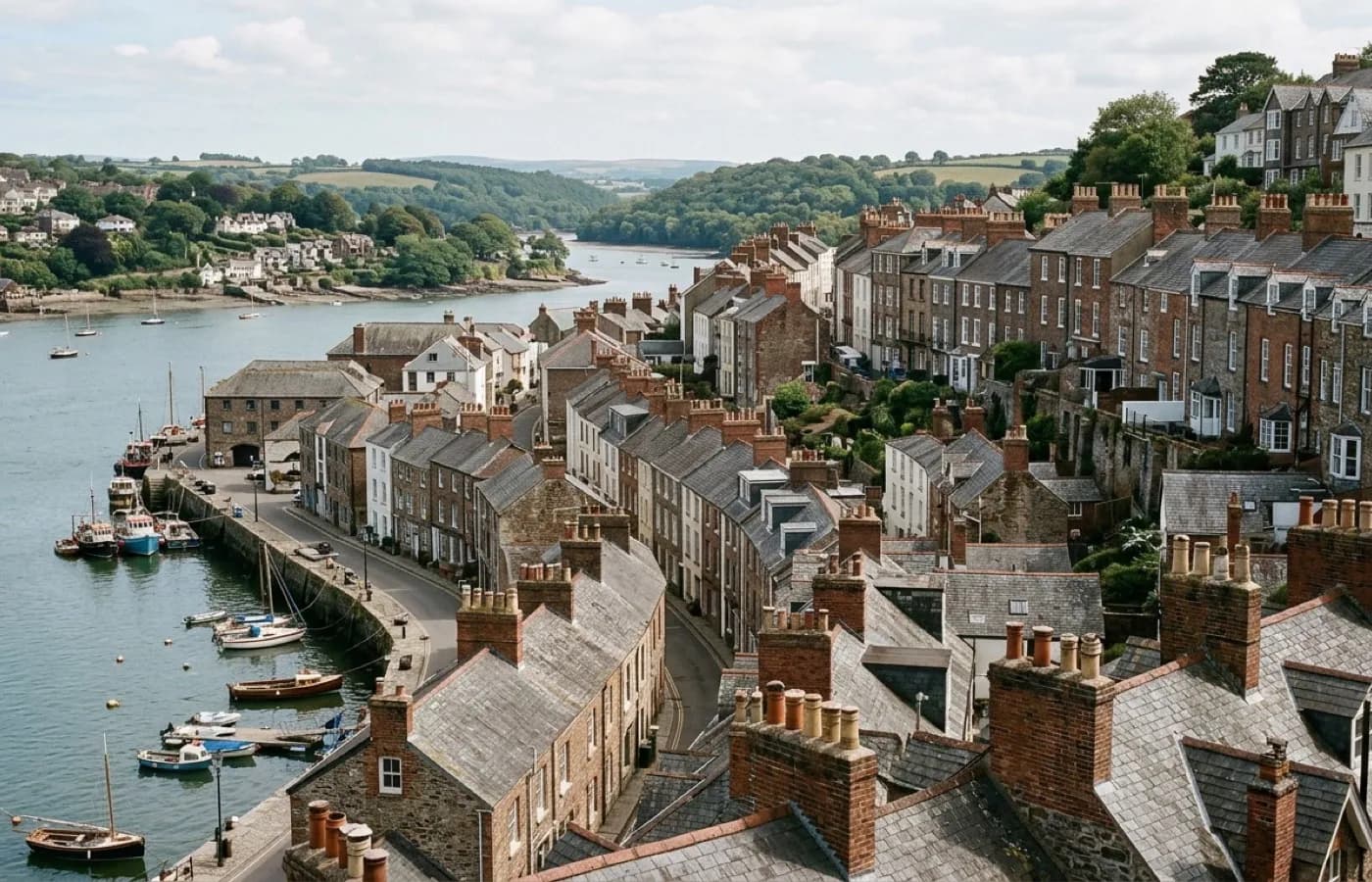
A railway-era town with Victorian terraces in large numbers, sitting low on the Teign floodplain where mist off the river keeps shaded stacks holding moss.
Railway-era terraces in numbers
Newton Abbot grew fast on the railway, and its Victorian railway-era terraces are among the largest single stock of that period this site covers, an ornate town centre from the same era carries its own more decorative stacks, and extensive post-war estates plus substantial modern development at Houghton Barton and Wolborough carry plainer, later chimneys well away from the older terraced streets.
Low, damp ground on the tidal Teign
The town sits on the flat floodplain where the Teign becomes tidal, ringed by hills, and that low-lying, damp position means mist off the river is a regular feature. Shaded slate and shaded stack faces hold moss and lichen readily as a result, and while the town is less wind-exposed than the coast a few miles away, the estuary funnels easterlies in through the winter months in a way that catches stacks built to face only the prevailing south-westerly.
A large stock, worth surveying properly
With so many similar-era railway terraces packed into the town, a single problem type, cracked flaunching from decades of shaded damp, tends to recur across a street rather than show up once, and a close aerial survey is a fast, ladder-free way to check a stack against exactly that pattern rather than assuming a neighbour's fault is or is not shared.
The racecourse and the old railway works
Newton Abbot Racecourse and the former Great Western Railway works both sit within the town, the latter a direct physical reminder of exactly the railway-era boom that produced the Victorian terraces this page has focused on. Stover Country Park, further out, sits away from the dense terraced streets in more recent, lower-density housing with simpler, less exposed stacks.
Teignmouth, Torquay, Totnes, Exeter and Dawlish are all close to Newton Abbot and all covered on their own pages, which is worth knowing since a booking here often fits naturally alongside a job in one of them.
The large-span industrial roofs on the trading estates carry little in the way of traditional chimney stock, which narrows this survey's real relevance in Newton Abbot mostly to the Victorian railway-era terraces and the town centre buildings from the same period, rather than the more recent commercial development around the edges.
The railway-era terraces typically carry a consistent run of matching clay pots along each roofline, a deliberate uniformity from an era when a whole street was often built by a single developer in one campaign rather than infilled house by house over time.
The racecourse and the wide roads around the trading estates make for straightforward launch points on the edge of town, while the older Victorian terraces nearer the centre generally need a side street or a car park found in advance.
Behind the survey
What Newton Abbot clients are actually buying
CAA registered
Operator ID and Flyer ID held, plus the A2 Certificate of Competency. Every survey is planned to the rules that apply to the site, and the paperwork is available before the visit if your sweep, roofer or agent wants it.
100 megapixel camera
A DJI Mavic 4 Pro with a Hasselblad camera and 6K video, close enough from a safe standoff distance to read a mortar joint or a hairline crack in a flaunching collar without leaning anything on the stack.
Radiometric thermal option
A DJI Mavic 2 Enterprise Advanced carrying a 640 by 512 thermal camera, flown alongside the visual pass where a damp pattern on a stack needs reading against the brickwork around it.
Insured with Coverdrone
Full commercial cover for the operation. Certificates go to sweeps, roofers, letting agents and insurers as a matter of course, without anyone having to chase for them.
Nearby
Also covered around Newton Abbot
- TeignmouthA resort and working port catching unusual easterly gales up the Channel, where Georgian and Regency front terraces carry stacks built for weather from the wrong direction.
- TorquayGrand Victorian and Edwardian villas across seven limestone hills, with elaborate Italianate roofscapes that are as hard to see properly from the street as they are to reach.
- TotnesA dense medieval and Elizabethan hill town with slate-hung frontages and jettied stacks, where tightly packed historic roofs trap debris in valleys and party-wall abutments.
- ExeterA cathedral city of tall Georgian and Victorian stacks over the old central quarters, where narrow streets make scaffolding a real cost before any repair has even been scoped.
- DawlishAmong the most storm-exposed places on the South Devon coast, where Regency and Victorian terraces around The Lawn sit close to cliff-top bungalow estates taking unbroken wind.
For the parts you cannot see from the ground
Book a chimney survey in Newton Abbot
Send the address and what is worrying you. Sam Hembury will come back with a fixed price and the next slot that suits the weather.